





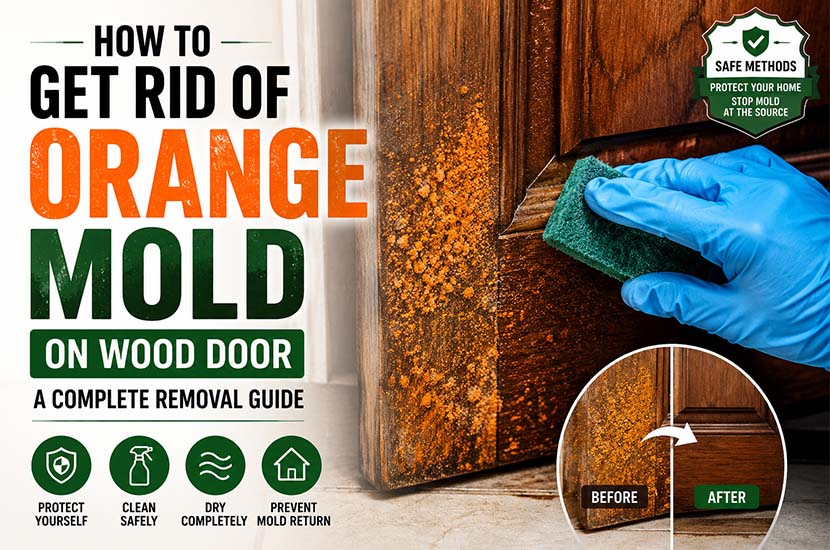
How to Get Rid of Orange Mold on Wood Door is a common question when you notice fuzzy, powdery, or slimy orange growth on a wooden door. The good news is that small amounts of surface mold can often be cleaned safely when you take the right precautions and fix the moisture problem causing it.
Keep in mind, always begin with your protection to remove orange mold: wear proper gloves, use eye protection, and an N95 respirator. After that, you have to clean the affected area with a suitable wood-safe method. Next, carefully dry the door completely, and fix the source of moisture to prevent the mold from returning.
Notably, for small areas, DIY cleanup may be possible. However, larger areas or extensive water damage is not something you should mess with. These solid mold-occupied areas may require professional mold remediation.
In this guide, you’ll learn how to remove orange mold from wood using methods such as vinegar, baking soda, water, and dish soap. Also, we’ll cover whether orange mold is dangerous, what kills mold on wood, and how to prevent it from coming back.
Quick Answer: How to Get Rid of Orange Mold on Wood Door
Crucially, anyone who is looking and needs the quickest safe overview, follow these steps:
- Protect yourself: Wear an N95 respirator, gloves, and safety goggles.
- Ventilate the area: Open windows or improve airflow where practical.
- Find the moisture source: Check for leaks, condensation, humidity, or water intrusion around the door.
- Choose a suitable cleaner: For a small surface patch, use a wood-appropriate cleaning solution such as white vinegar or 3% hydrogen peroxide, testing an inconspicuous area first.
- Apply the cleaner: Treat the affected area without unnecessarily soaking the wood.
- Scrub gently: Work with the direction of the wood grain.
- Wipe the surface: Remove loosened residue with a clean, damp cloth.
- Dry the door completely: Use airflow or a fan and avoid leaving the wood damp.
- Monitor the area: If the orange growth returns, the underlying moisture problem has probably not been resolved.
- Call a professional: Get professional help when the affected area is large, the wood is soft or damaged, mold keeps returning, or contamination extends into hidden areas.
Most importantly, thinking that cleaning visible mold alone is enough, it is just a myth and not a permanent solution at all. To simplify, mold grows where moisture persists, so moisture control is the foundation of long-term mold prevention. Moreover, the EPA recommends keeping indoor relative humidity below 60%, ideally between 30% and 50%.
What Is Orange Mold on a Wood Door?
“Orange mold” is a general visual description rather than the name of one specific mold species. Furthermore, orange, rust-colored, peach, pinkish, or yellow-orange growth can have different causes, and not every orange-colored substance on wood is actually mold.
In addition to that, you will start observing orange growth appear on wood. However, the question is: why is this happening? Simply, this orange growth begins when moisture, organic material, and suitable environmental conditions allow fungal growth to develop. Keep in mind, wood is one of the organic materials that are particularly vulnerable because it can absorb and retain moisture.
You may notice orange growth as:
- Bright orange patches
- Rust-colored spots
- Peach or pinkish growth
- Fuzzy colonies
- Powdery orange residue
- Slimy or wet-looking patches
- Crusty or dried growth
- Irregular clusters
What’s more, people think the appearance alone can help them identify mold species. Unfortunately, that is not the case only mold color cannot reliably tell you which species is present. In fact, the CDC notes that mold can appear in many colors and recommends removing visible mold rather than relying on color alone to determine its significance.
How to Tell If Orange Growth on Wood Is Actually Mold
Interestingly, you have to check this before cleaning your door. Also, make sure you are not mistaking another type of discoloration for mold.
Orange Mold
Certainly, these signs will help you a lot to determine whether this orange growth is mold or something else. Notably, orange mold may have:
- A fuzzy, powdery, slimy, or textured appearance
- Irregular patches or clusters
- A musty or earthy smell
- A tendency to return when moisture remains
- Growth concentrated around damp areas.
Rust or Metal Staining
Keep in mind, rust usually produces a relatively flat orange-brown stain. So, if the discoloration originates from metal hardware, hinges, screws, or nearby plumbing, rust may be responsible rather than mold.
Wood Discoloration
Mistakenly, several people took all wood discolorations as mold growth. However, wood can naturally develop changes in color from age, moisture, tannins, staining, sunlight, or chemical reactions. Therefore, do not mistake a flat discoloration that follows the grain as mold; it may not be fungal growth.
Paint or Finish Problems
We are well aware that paint can become discolored, blistered, or damaged because of moisture. Especially if the surface is smooth rather than fuzzy or textured, investigate whether the problem is with the coating itself.
Why Identification Matters
Certainly, if you clean what you think is mold but the orange discoloration remains, do not keep applying stronger chemicals blindly. To simplify, you may be dealing with staining or damage rather than active mold.
Why Does Orange Mold Grow on Wood Doors?
To be clear, moisture is like a lifeline for mold to grow. Therefore, a wood door can become vulnerable when it repeatedly encounters condensation, leaks, high humidity, wet floors, bathroom steam, or poor ventilation.
For this reason, the common causes include:
1. High Humidity
As we have mentioned above, humidity works as a key for mold to enter its target. Because of this, excessive indoor humidity can keep wooden surfaces damp. As a result, it provides enough way for mold growth.
Note: The EPA recommends keeping indoor relative humidity below 60%, with an ideal target of approximately 30% to 50%.
2. Condensation
Surely, any wood door that is located near a bathroom, kitchen, laundry area, or poorly insulated wall may repeatedly collect condensation. Thus, it becomes highly susceptible possible and easy prey for mold.
3. Water Leaks
Sadly, it is the most common reason behind mold growth, yet people neglect it badly. A leaking pipe, roof problem, plumbing fixture, or water intrusion around a doorway can provide a continuing moisture source.
4. Poor Ventilation
Indeed, when the ventilation is not proper, it makes it difficult for humid air to leave the area. So, when humid air cannot escape, moisture can remain on wooden surfaces for long periods.
5. Wet Flooring
Another common cause is wet flooring. Water from mopping, bathrooms, showers, or spills can repeatedly reach the bottom section of a wooden door.
6. Damp Weather
Primarily, exterior wooden doors are particularly vulnerable when exposed to rain, poor drainage, or prolonged humidity.
7. Damaged Paint or Sealant
Simply put, once the protective finish on a wood door deteriorates, water can penetrate the underlying wood more easily.
How to Get Rid of Orange Mold on Wood Door Step by Step
Note that if you are dealing with a small, localized patch, of orange mold on wood door, use the following process.
Step 1: Protect Yourself
Most importantly, do not forget to always protect yourself before disturbing mold; put on:
- N95 respirator or equivalent respiratory protection
- Rubber or nitrile gloves
- Safety goggles
- Washable clothing or disposable protective clothing
Notably, the CDC recommends at least an N95 respirator for people cleaning mold. Also, the CDC advises that people suffering from certain health conditions such as significant allergies, immune suppression, or underlying lung disease should not participate in mold cleanup.
Moreover, never use a dry brush mold aggressively, otherwise, doing such a thing disturbs the mold growth. Consequently, it can release particles into the air.
Step 2: Ventilate the Area
Indeed, ventilation is essential, not only for orange mold but also to get rid of all mold types. Thus, focus on improving ventilation where possible. For this purpose, open suitable windows or use ventilation systems that do not spread contaminated air to other areas.
Beware: if the mold problem is extensive, avoid creating unnecessary airflow that could distribute spores throughout the home.
Step 3: Identify the Moisture Source
Certainly, if you remain unsuccessful in identifying the original moisture source behind the entire mold problem, all your efforts to get rid of it will go to waste. Therefore, before cleaning, ask:
- Is the door near a bathroom?
- Is there condensation around the door?
- Is water reaching the bottom of the door?
- Is there a plumbing leak nearby?
- Is the wall around the door damp?
- Is outdoor rain entering around the frame?
- Is the room consistently humid?
Keep in mind, if you do not correct the underlying moisture problem, the mold can return after cleaning.
This is why the CDC specifically recommends both cleaning mold and fixing the moisture problem responsible for its growth.
Step 4: Test Your Cleaning Solution
Never go for mold cleaning quickly without proper thinking. To elaborate, wood finishes vary. That is why it is important test a cleaner on a small area. Rather than directly applying vinegar, hydrogen peroxide, baking soda, or another cleaner to a visible section.
Consider this: it helps you check for:
- Discoloration
- Bleaching
- Damage to varnish
- Changes in sheen
- Damage to paint or stain
Step 5: Apply the Cleaning Solution
Apply your selected cleaner to the affected area without unnecessarily saturating the wood.
Clearly, the goal is to treat the visible mold while minimizing additional moisture absorption.
Step 6: Scrub Gently
Firstly, it is best to use a soft-bristled brush or microfiber cloth.
Secondly, only work in the direction of the wood grain rather than aggressively scrubbing across it.
Crucially, avoid damaging the finish because scratched or deteriorated wood can become more vulnerable to moisture.
Step 7: Wipe the Door Clean
Use a clean, slightly damp cloth to remove loosened residue.
Do not leave standing water on the door.
Step 8: Dry the Wood Completely
Surely, drying is one of the most important steps when it comes to removing orange mold from a wood door.
Use:
- A clean towel
- A fan
- Improved ventilation
- A dehumidifier when necessary
Crucially, always remember the EPA emphasizes moisture control as the key to preventing mold. Also, it notes that drying wet materials within roughly 24–48 hours can help prevent mold growth after leaks or spills.
Step 9: Monitor the Door
Properly and carefully inspect the area regularly after cleaning.
If you notice:
- Orange growth returning
- A persistent musty smell
- New dampness
- Softening wood
- Peeling paint
- Repeated discoloration
Clearly, it leads to the conclusion that the underlying problem may be deeper than surface mold.
How to Get Rid of Orange Mold on Wood Door With Vinegar
Significantly, people prefer and so commonly use white distilled vinegar as a household cleaner for small surface mold problems.
To put it simply, here are the steps for how to get rid of orange mold on wood door with vinegar. For a small affected area:
- Put on protective equipment.
- Test vinegar on an inconspicuous part of the door.
- Apply white distilled vinegar to the affected area.
- Allow appropriate contact time according to the cleaning method and product guidance.
- Gently scrub with the wood grain.
- Wipe away residue.
- Dry the door thoroughly.
Importantly, Don’t Soak the Door
Beware, wood is porous. Evidently, if you flood a wooden door with liquid, it can lead to more moisture in the material.
That is particularly counterproductive if moisture is already causing the mold.
Vinegar may also affect certain finishes, so always perform a small spot test first.
How to Get Rid of Orange Mold on Wood Door With Vinegar and Baking Soda
Unfortunately, many people frequently spread the misconception of recommending to use vinegar and baking soda together online. However, there is an important practical issue: combining them causes an acid-base reaction that produces carbon dioxide and reduces the useful properties of each ingredient.
Instead, you should avoid mixing a large quantity of vinegar and baking soda together, use them separately if appropriate.
Option 1: Vinegar First
Firstly, apply white distilled vinegar to the affected area, then clean and dry the surface.
Option 2: Baking Soda as a Separate Cleaner
To make it simple, create a small paste using baking soda and water.
After that, apply it gently to the affected surface, scrub lightly, and wipe the residue away. Finally, dry the wood.
Surprisingly, you can use baking soda for gentle surface cleaning. Indeed, baking soda can be useful for such cleaning. Yet, you should not treat baking soda as a guaranteed solution for deeply embedded mold.
How to Get Rid of Orange Mold on Wood Door With Vinegar and Water
Clearly, if you dilute vinegar with water, it may reduce its cleaning strength. Also, know that adding more water to a porous wood door can increase moisture exposure.
So, if you choose to use diluted vinegar:
- Test it on an inconspicuous area.
- Apply only enough solution to treat the affected surface.
- Avoid soaking the wood.
- Wipe away excess moisture.
- Dry the door completely.
Keep in mind, for anyone dealing with heavily affected or recurring mold, changing the vinegar-to-water ratio is not a substitute for identifying the moisture source.
How to Get Rid of Orange Mold on Wood Door With Vinegar and Dawn
Surely, there are dish soaps such as Dawn can help loosen dirt, grime, and surface residue. However, believing or considering soap by itself as a complete mold-remediation solution is totally wrong approach.
For a finished wood door, you can use a small amount of mild dish soap with water for surface cleaning, followed by thorough drying.
Notably, if you are planning to use vinegar as well, do not mix cleaning chemicals indiscriminately. It is often assumed, more ingredients will have a powerful impact. The truth is, mixing ingredients scheme do not necessarily produce a stronger or safer mold cleaner.
Most importantly, the CDC specifically warns never to mix bleach with ammonia or other cleaners because dangerous gases can be produced.
What Kills Mold on Wood?
Keep in mind, you will not find a single household ingredient that is a universal cure for mold on wood. Thus, you should not treat any household ingredient as such a solution for wood mold.
The effective approach is a combination of:
- Removing visible growth
- Cleaning the affected surface appropriately
- Drying the wood
- Correcting the moisture source
- Preventing recurrence
It is widely believed that white vinegar and 3% hydrogen peroxide will always be best for small surface cleaning. The truth is, their suitability depends on the wood, finish, severity, and location.
Note: For recurring or deeply embedded growth, professional remediation may be necessary.
Most importantly, killing or removing visible mold without fixing moisture is not enough. The EPA identifies moisture control as the key to mold control.
What Kills Black Mold on Wood?
There is a misconception that black mold is very lethal. However, this is wrong; black mold is not automatically more dangerous simply because it is black. We talk about this in many articles; mold color alone cannot tell you the species or determine the level of health risk.
Clearly, the CDC states that mold can appear in many colors and recommends removing mold regardless of its color.
Now let’s deal with the question of what kills black mold on wood. For black mold growing on a wood door, the same principles apply:
- Protect yourself
- Limit disturbance
- Clean small surface areas appropriately
- Dry the wood
- Fix the moisture problem.
- Get professional assistance when the contamination is extensive or recurring.
Importantly, if the wood is soft, structurally damaged, heavily contaminated, or mold is growing inside hidden areas, do not rely on household cleaning alone.
Is Orange Mold on Wood Dangerous?
Certainly, orange mold on wood can be a health concern. As we have mentioned above, the color alone does not tell you how dangerous it is.
To elaborate, there are several types of molds. Evidently, different molds can have different effects. What’s more, some people experience no symptoms while others may develop irritation or allergic reactions.
Hopefully, you will find this advice and information from the CDC a lot helpful. Exposure to damp and moldy environments can be associated with symptoms such as:
- Sneezing
- Nasal congestion
- Coughing
- Wheezing
- Red or itchy eyes
- Skin irritation
- Respiratory symptoms
Surely, people already suffering from allergies or asthma may experience stronger reactions. Additionally, people with weakened immune systems or certain underlying lung conditions can face more serious risks.
Therefore, it is better to treat visible mold as a moisture and indoor-environment problem rather than trying to determine its danger from its orange color alone.
Is Orange Mold Dangerous to Humans?
It can be, particularly for people who are sensitive to mold or have certain underlying health conditions.
However, it is not right to jump to this conclusion from such situations that every orange-colored mold is toxic.
Notably, the CDC explains that exposure to moldy environments can cause health effects in some people and no noticeable effects in others. As we are well aware, the case can be very different for sensitive individuals as they can experience allergic and respiratory symptoms. Furthermore, people with asthma are more vulnerable and may experience worsening symptoms.
Potential symptoms can include:
- Sneezing
- Runny or stuffy nose
- Coughing
- Wheezing
- Throat irritation
- Red or watery eyes
- Skin rash
Most importantly, if significant or persistent symptoms occur after exposure to mold, medical advice should be sought.
Is Orange Fungus on Wood Poisonous?
Indeed, it is not necessarily true that orange fungus on wood poisonous.
To put it simply, the term “orange fungus” describes appearance rather than a single organism. It should be noted, it is not that easy for you to determine whether a growth is poisonous simply by looking at its color. It is impossible.
No doubt, some fungal organisms can produce substances that may be harmful under particular circumstances. However, it would be completely misleading to label all orange growth on wood as poisonous.
For household purposes, the safer approach is simple: do not handle or disturb visible mold unnecessarily, remove it safely, and correct the moisture problem.
Notably, the CDC does not recommend relying on home mold testing to determine whether someone will become sick. Clearly, the instructions and their guidance emphasize safe removal and moisture control instead.
Powdery Orange Mold on Wood: What Does It Mean?
Pay attention to the look of powdery orange mold on wood, which can be very different from wet or slimy growth.
Keep in mind, it may appear as:
- Fine orange dust
- Dry powder
- Rust-colored residue
- Fuzzy dry patches
- Flaky orange growth
However, this is not the right approach to stamp every powdery orange discoloration as mold. Importantly, powdery orange discoloration can also be caused by non-mold substances.
Crucially, remember if you notice that the material is easily disturbed. So, avoid brushing it aggressively because loose particles can become airborne.
Instead:
- Put on appropriate protective equipment.
- Determine whether the material is actually mold.
- Clean a small surface area carefully.
- Dry the wood.
- Investigate the moisture source.
- Monitor for recurrence.
If the powdery growth keeps returning, the wood door or any other wood may have an ongoing moisture problem.
How to Get Rid of Orange Mold on Walls
Certainly, the main focus of this article is wood doors. Yet, we also cover mold on walls, as orange mold may also appear on nearby walls.
The process of how to get rid of orange on walls depends on the wall material.
For a small surface area:
- Wear appropriate protective equipment.
- Improve ventilation.
- Avoid aggressive dry brushing.
- Clean the affected surface using a suitable method for that material.
- Dry the area thoroughly.
- Fix the underlying moisture source.
Keep in mind, assuming a wall can be treated exactly like a wooden door is wrong.
A critical point: only cleaning the visible mold surface may not solve the problem. Especially, if mold has penetrated the drywall or another porous building material, cleaning only the visible surface may not solve the problem.
If the contamination is extensive, recurring, or associated with water damage, professional assessment is appropriate. EPA guidance generally uses approximately 10 square feet as an important threshold for deciding whether DIY cleanup is appropriate.
How to Get Rid of Mould in Bathroom Permanently
Mistakenly, you think that by only spraying cleaner in the bathroom, you can permanently prevent bathroom mold. Believe me, this is not going to happen.
Instead, you have to do it the proper way, which is the long-term solution, and that is moisture control.
Improve Bathroom Ventilation
Utilize the exhaust fan during and after showers when appropriate. Surely, it will aid a lot in achieving your goal.
Reduce Humidity
Importantly, a dehumidifier is a vital step further towards reducing moisture. Thus, use it if the bathroom or adjoining area remains excessively humid.
Dry Wet Surfaces
Promptly, dry all the wet surfaces and do not allow water to remain around:
- Door frames
- Wooden trim
- Cabinets
- Floors
- Window frames
Fix Leaks
Inspect:
- Pipes
- Faucets
- Shower connections
- Toilets
- Sink plumbing
Check the Door
If orange mold repeatedly appears on a bathroom door, inspect the bottom edge, frame, hinges, surrounding wall, and nearby flooring for moisture.
Keep Humidity Under Control
Remember this: the EPA recommends indoor relative humidity below 60%, ideally around 30–50%.
How to Get Rid of Mold Spores in the Air Naturally
As we have mentioned before, you cannot win by removing visible mold only. Likewise, the best way to reduce airborne mold spores is not simply to “kill” them in the air. It is mandatory, to remove the source and prevent more spores from becoming airborne.
Therefore, focus on:
Remove Visible Mold Safely
Removing visible mold is not enough. However, it is one of the sources for airborne mold spores, if not treated carefully. Thus, safely clean the source instead of relying on air treatment alone.
Fix Moisture
If mold continues growing, airborne spores can continue to be generated.
Improve Ventilation
Appropriate ventilation helps control humidity.
Use a HEPA Air Cleaner
Indeed, a properly selected HEPA air purifier can help capture airborne particles, but it should be viewed as a supplement rather than a replacement for mold cleanup and moisture control.
Keep Indoor Humidity Controlled
Maintaining humidity below 60%, ideally 30–50%, can make the environment less favorable for mold growth.
Do Not Depend on Air Purification Alone
An air purifier cannot repair a leaking pipe, wet wooden door, damp wall, or hidden water intrusion.
Note: source removal comes first.
Orange Mold on Mattress: What Should You Do?
Specifically, if you are dealing with orange mold on a mattress, know that it requires more caution because mattresses are highly porous.
Additionally, if the mold on your mattress is extensive or deeply embedded, attempting to clean only the visible surface may not remove contamination throughout the material.
For a small, questionable spot:
- Avoid aggressively brushing it indoors.
- Isolate the affected area from other fabrics.
- Identify the moisture source.
- Consider professional assessment.
Note that if your mattress has substantial mold growth or persistent mold odor, replacement may be more practical than attempting to restore the interior.
Most importantly, find out why the mattress became damp in the first place. Otherwise, you might face the same mold problem with a new mattress after some time.
Orange Mold on Food: Is It Safe?
Without a doubt, orange-colored mold can appear on food. Unfortunately, several people think that, scraping away the visible portion makes moldy food safe to eat. However, this assumption is totally wrong and very unsafe.
Simply, you have to learn that mold can extend beyond what is visible, particularly in soft or porous foods.
For questionable food, follow appropriate food-safety guidance rather than treating it like mold on a wooden surface.
Most importantly, vinegar, bleach, or household mold cleaners are not food. So, please never use these to “save” moldy food.
Can Orange Mold Damage a Wood Door?
Yes, there is no doubt that persistent moisture and fungal growth can contribute to the deterioration of wood.
Besides, the matter is not as simple as it looks; visible orange growth itself may be only part of the problem. If moisture has remained inside the door for a prolonged period, you may also notice:
- Soft spots
- Swelling
- Warping
- Peeling finish
- Discoloration
- Cracking
- Persistent musty odor
Notably, if your door now becomes soft or structurally compromised, cleaning the surface may not be enough.
When Should You Replace a Moldy Wood Door?
Indeed, you don’t need to replace a wood door just because you find a small amount of mold on it.
Instead, a door may be salvageable when:
- Growth is superficial
- The wood remains structurally sound.
- The moisture source can be fixed.
- The finish remains intact.
- Mold does not return after proper cleaning.
However, you should adapt replacement approach in case it becomes more appropriate when:
- The wood is extensively rotten.
- The door has significant structural damage.
- Mold is deeply embedded.
- The door repeatedly becomes moldy.
- Moisture has penetrated extensively.
- Restoration would be impractical
Keep in mind, it is much better to let a professional help determine whether remediation or replacement makes more sense. Rather than deciding yourself and later on regretting your decision.
How to Prevent Orange Mold From Coming Back
Surely, you cannot sit down and relax just after getting rid mold, cleaning the mold is only half the job.
The real goal is to make the wood door an environment where mold cannot easily grow again.
Keep Indoor Humidity Low
For this purpose, you can utilize a hygrometer, use it to monitor indoor humidity.
Remember, you should aim for approximately 30–50% relative humidity, while keeping it below 60%.
Fix Leaks Immediately
Importantly, you have to carefully inspect nearby plumbing, walls, ceilings, and flooring promptly.
Even a small recurring leak can keep wood damp.
Improve Airflow
Understandably, if you have poor airflow, then it allows moisture to remain trapped around wooden surfaces. Consequently, this airflow leads to mold.
Keep the Door Dry
Pay special attention to the bottom of bathroom or exterior doors.
Repair Damaged Finishes
Peeling paint, cracked sealant, and damaged protective coatings can allow moisture to reach the wood underneath. Thus, quickly repair any damage you find.
Inspect the Door Regularly
Check for:
- New discoloration
- Musty odors
- Dampness
- Peeling paint
- Soft wood
- Recurring mold
Notably, early detection makes the problem much easier to manage and prevent costly solutions.
Should You Seal a Wood Door After Removing Mold?
A suitable protective finish can reduce the amount of moisture absorbed by wood, but sealing should not be used to trap an existing moisture problem underneath the finish.
Hence, always take a few steps before sealing:
- Remove the visible mold.
- Correct the moisture source.
- Allow the wood to dry completely.
- Make sure the surface is suitable for refinishing.
- Apply an appropriate wood finish or coating according to the manufacturer’s instructions.
Clearly, if moisture remains inside the wood, sealing over it can create additional problems rather than solving the underlying issue.
When Should You Call a Professional Mold Remediation Company?
Generally, many people try DIY cleanup every time. However, it is not appropriate for every situation.
According to EPA guidance, moldy areas smaller than about 10 square feet can often be handled by homeowners, while larger areas or extensive water damage warrant additional professional consideration.
Certainly, you should consider professional remediation when:
- Mold covers more than approximately 10 square feet.
- The mold keeps returning.
- The wood is soft or rotting.
- There has been extensive water damage.
- Mold is inside walls or other hidden areas
- HVAC systems may be contaminated
- There is a persistent musty smell.
- The source of moisture cannot be identified.
- Someone in the household is particularly vulnerable to mold exposure.
The CDC specifically advises that people with allergies, immune suppression, certain underlying lung conditions, or chronic respiratory diseases should not participate in mold cleanup.
Common Mistakes to Avoid When Removing Orange Mold From Wood
Below, we are presenting almost all common mistakes:
1. Using Too Much Water
Unfortunately, people make this mistake so often, not realizing that the wood is porous. So, excessive water can make the moisture problem worse.
2. Scrubbing Aggressively
Homeowners sometimes assume hard scrubbing will help clean mold properly. Conversely, hard scrubbing can damage the wood finish and spread contaminated material.
3. Using Bleach Automatically
Bleach is not a universal answer for mold on porous wood. More importantly, never mix bleach with ammonia or other cleaners, because dangerous gases can result.
4. Cleaning Without Fixing the Leak
Without a doubt, the one mistake that waste all your mold cleaning efforts is not fixing leaks. This is one of the biggest mistakes.
Keep in mind, if the moisture remains, mold can return.
5. Assuming Orange Means Toxic
Color alone does not identify a mold species or determine its health risk.
6. Ignoring Recurring Growth
If mold repeatedly appears in exactly the same location, investigate the surrounding structure rather than repeatedly cleaning the surface.
7. Treating an Entirely Moldy Door as a Simple Surface Problem
Beware: a small patch is very different from extensive growth, soft wood, or hidden water damage.
DIY vs. Professional Mold Removal
| Situation | DIY Cleaning | Professional Help |
| Small surface patch | Usually reasonable | Optional |
| Less than ~10 sq. ft. | Often manageable | Consider if recurring |
| Large area | Not recommended | Recommended |
| Repeated mold growth | Limited usefulness | Recommended |
| Soft or rotting wood | Not appropriate | Recommended |
| Hidden mold | Not appropriate | Recommended |
| Major water damage | Not appropriate | Recommended |
| HVAC contamination | Not appropriate | Recommended |
| Persistent musty odor | Investigate | Consider professional inspection |
The EPA’s approximately 10-square-foot guideline is a useful starting point, but the actual decision also depends on water damage, location, material, recurrence, and the people occupying the home.
Conclusion
How to Get Rid of Orange Mold on Wood Door starts with safely removing the visible growth, but the real solution is addressing whatever is keeping the door or surrounding area damp. For a small surface patch, careful cleaning followed by complete drying may be enough. However, recurring growth, soft wood, hidden moisture, or extensive contamination can indicate a larger problem that requires professional attention.
Therefore, if the mold keeps returning or you are unsure whether the affected wood can be safely restored, Miami Mold Specialists can help assess the situation and provide professional mold remediation services in Miami and surrounding areas. Additionally, their team can identify moisture-related problems, address affected areas, and help determine whether remediation or replacement is the better option. Indeed, taking action early can help prevent a small mold problem from becoming a more extensive moisture and property-damage issue.