




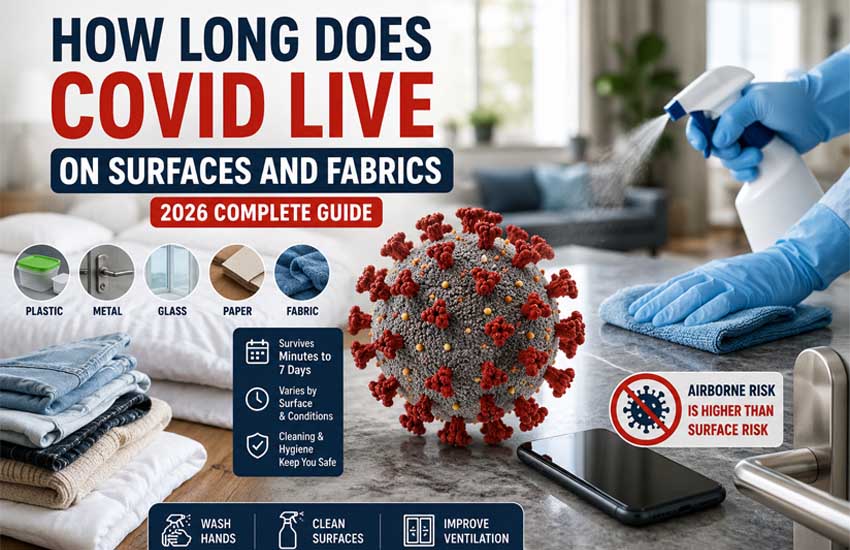
Understanding how long does COVID live on surfaces and fabrics has become an essential part of our lives for protecting our homes, workplace, and health. This is the reason why many people still wonder how Covid-19 survives on different materials, whether the virus can linger on surfaces, bedding, clothing, or even in the air. Not only that, but people also want to know how long COVID-19 can linger.
Rest assured, this detailed guide answers every major question, including surfaces, fabrics, air survival, and real-world risks. Certainly, it is based on updated research and practical insights.
What Is COVID-19 and How Does It Spread?
No doubt, COVID-19 is a contagious respiratory illness. So, it is very easy to understand that this disease primarily spreads through:
- Airborne droplets (coughing, sneezing, talking)
- Aerosols in enclosed spaces
- Contact with contaminated surfaces (rare but possible)
Importantly:
Modern research shows airborne transmission is the main cause behind the spread of COVID-19. However, there are certain situations where surface contamination can still contribute.
How Long Does COVID Live on Surfaces and Fabrics?
The survival time depends on:
- Surface type (hard vs porous)
- Temperature
- Humidity
- Sunlight exposure
Quick Answer (2025 Updated)
| Surface Type | Estimated Survival Time |
|---|---|
| Plastic | 3–7 days |
| Stainless Steel | Up to 7 days |
| Glass | Approximately 4 days |
| Paper | 30 minutes to 24 hours |
| Cardboard | Up to 24 hours |
| Fabrics (Clothes & Bedding) | Up to 2 days |
Notably, the virus survives longer on hard surfaces and shorter on fabrics. Simply, the porous materials absorb and dry out droplets faster.
How Long Does COVID Live on Surfaces 2024 vs 2025?
You will find several people searching:
- “How long does COVID live on surfaces 2024”
- “How long does COVID live on surfaces 2025”
Certainly, the clear answer to these questions is:
There is no major change in survival time, but understanding has improved.Updated Reality:
- Virus can remain detectable for days
- But infectious risk drops quickly
- Surface transmission is now considered low risk
How Long Does COVID Live on Hard Surfaces?
Hard, non-porous surfaces allow the virus to survive the longest.Examples:
- Plastic
- Metal
- Glass
- Countertops
Now we can say that the virus survival time is:
3 to 7 days (under ideal lab conditions)Real-life scenario:
- Sunlight, heat, and airflow: these 3 things reduce survival drastically
- In most homes, the virus becomes inactive much sooner
How Long Does COVID Live on Fabrics and Bedding?
Below, we are providing you with a simpler but a bit more detailed answer:
How long can COVID live on bedding?
Certainly, the COVID virus can survive on:
- Bedsheets
- Blankets
- Clothing
However, the typical duration is:
Up to 48 hours (2 days)
Why shorter survival?
- Fabrics absorb moisture
- Virus dries out faster
- Less stable environment
Importantly, you should know that the risk from bedding is very low, but washing is still recommended.
How long does COVID live on paper?
Clearly, we know that paper is porous. Therefore, the virus breaks down quickly.
- Around 30 minutes to a few hours
- In some cases, up to 24 hours
How Long Can COVID Live on Food?
Good News, food is not a major transmission source.
- No strong evidence backs the idea of transmission via food
- Virus may survive briefly on packaging
How long does COVID live on surfaces in car?
The COVID virus survives on the surface of your car depending on these two important factors:
- Temperature inside the vehicle
- Sun exposure in and on a car
Example:
- Hot car (above 70°F / 21°C): virus dies within minutes
- Cooler conditions in a car may help the virus last longer on surfaces
How Long Does COVID Stay in the Air and on Surfaces?
To simply explain the stay of COVID in the air and on surfaces, please carefully read this:Air:
- Can remain airborne for up to 3 hours (or more in enclosed spaces)
Surfaces:
- From minutes to days, depending on the material
Beware, airborne spread is much more dangerous compared to surfaces.
Can You Spread COVID Through Surfaces?
Yes, surely COVID can spread through surfaces. However, this type of spread via surfaces is very rare.Moreover, this sort of spread requires multiple steps:
- Surface contamination
- Touching the surface
- Touching face (eyes, nose, mouth)
Consequently, to an extent, we can say surface transmission is possible but unlikely.
What to Throw Away After COVID?
Indeed, several people get confused about this; they need to know what to throw away after COVID. Usually, nothing needs to be thrown away.Instead:
- Wash clothes and bedding
- Disinfect high-touch surfaces
Additionally, you need to make sure that you dispose of:
- Used tissues
- Disposable masks
After that, relax, you do not need to throw furniture, clothes, or belongings.
How Long Does COVID Stay in a Room?
Let’s carefully see the reasons and factors behind the virus staying in your room.
- Aerosols can linger for hours
- Poor ventilation increases risk
Factors:
- Room size
- Airflow
- Number of people
To your surprise, a very simple yet efficient way to reduce the dangers is good ventilation. Without a doubt, this step of ventilation improvement can reduce risk significantly within 1–3 hours.
How Long Can COVID Live on Bedsheets?
Stop worrying, this is something you can easily manage:
- COVID can live on bed sheets up to 2 days
- Much lower risk than hard surfaces
Also, washing with warm water is enough to remove the virus.
Key Factors That Affect COVID Survival
Here, we are going to discuss some vital factors that affect COVID survival:
Temperature
Higher temperature = shorter survival
Humidity
- Low humidity = longer survival
Surface Type
- Hard = longer survival
- Fabric = shorter survival
Sunlight (UV)
- UV light kills the virus instantly
How to Disinfect Surfaces Properly
Anyone who is wondering about disinfecting surfaces properly does not need to worry. Below, we are mentioning simple cleaning steps:
- Clean with soap and water
- Use disinfectant if needed
Also, you need to focus on high-touch areas:
- Doorknobs
- Phones
- Tables
- Light switches
Furthermore, most household disinfectants kill COVID effectively.
Do You Need Professional Disinfection?
Indeed, yes. Clearly, there are some cases, especially when:
- Offices
- Commercial spaces
- Medical environments
- Severe contamination
Professional services use:
- Medical-grade disinfectants
- Advanced sterilization methods
Final Takeaways
Now, let’s once again carefully understand these essentials:
- COVID survives longer on hard surfaces (3–7 days)
- On fabrics, it lasts around 2 days
- On paper, less than 24 hours
- Airborne transmission is the main risk
- Surface spread is rare but possible
You must know, the best protection:
- Hand hygiene
- Regular cleaning
- Good ventilation
FAQs (Quick Answers)
We are providing the most efficient, short, and simple answers to some questions people often ask:
How long does COVID live on surfaces 2025?
According to lab COVID live on surfaces up to 7 days. However, real-world risk is low.
How long can COVID live on bedding?
The clear answer is around 2 days.
Can COVID spread through surfaces?
This is very rare.
How long does COVID stay in the air?
Up to several hours
Conclusion
Understanding How Long Does COVID Live on Surfaces and Fabrics helps you make smarter decisions about cleaning, hygiene, and safety in everyday life. Additionally, the virus can remain on certain surfaces for hours to days; the real-world risk is generally low when proper cleaning and ventilation practices are followed.However, in high-risk environments like offices, commercial spaces, or after confirmed exposure, basic cleaning may not be enough. This is where professional help becomes important. Miami Mold Specialists offers advanced, medical-grade disinfection and sanitization services designed to eliminate viruses, bacteria, and contaminants effectively.Therefore, if you want complete peace of mind and a safer environment, choosing expert-level disinfection is always the smartest step.