




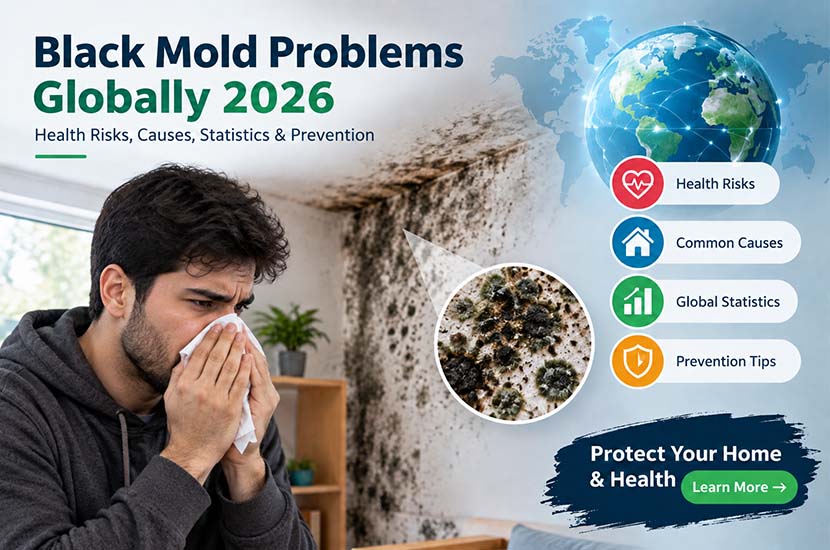
Black mold problems globally 2026 remain closely connected to one major factor: moisture. Certainly, mold can attack your precious and hard-earned homes, apartments, offices, schools, and other buildings. Importantly, mold infestation gets its best chance when leaks, flooding, condensation, high humidity, or poor ventilation create persistently damp conditions.
It is widely believed every dark-colored mold is “black mold”. In fact, this is just a misconception; you need to understand that not every dark-colored mold is “black mold,” and household mold exposure should not automatically be described as toxic poisoning. Instead, the better-established concerns involve allergies, respiratory irritation, and worsening asthma symptoms. On the other hand, serious invasive fungal infections are much rarer and primarily affect people with significantly weakened immune systems.
What Is Black Mold?
“Black mold” is a common term rather than a precise scientific category. One species commonly associated with the term is Stachybotrys chartarum. However, you should know other molds can also appear black or dark.
Therefore, you can determine or identify a mold species only on the basis of color alone. Likewise, you cannot make a decision using this vague info about how dangerous it is.
For homeowners, the more important questions are:
Where is the moisture coming from?
How long has the material been wet?
Is the mold recurring?
Can the moisture source be fixed?
Keep in mind, the EPA emphasizes moisture control as the central strategy for preventing indoor mold growth.
How Common Are Mold Problems?
To be clear, right now there is no single reliable global percentage for homes containing specifically “black mold.” Simply, estimates vary depending on whether researchers measure visible mold, mold odor, dampness, water damage, or specific species.
However, we can understand this much based on the supplied research cites estimates suggesting that 20%–68% of U.S. homes show some sign of dampness or mold. However, other sources report different figures depending on methodology.
This means these statistics should not be presented as a universal global percentage for black mold.
Hence, what can be said confidently and safely is that indoor dampness and mold are widespread building problems. Specifically, these problems are occurring where moisture is not properly controlled.
What Causes Black Mold to Grow?
Indeed, it is not hard for you to understand and remember with this basic formula:
Moisture + suitable material + enough time = mold growth
To elaborate, we are mentioning below the common causes include:
- Water leaks from pipes, roofs, or windows
- Flooding and storm-related water intrusion
- High indoor humidity
- Condensation on cold walls and windows
- Damp basements and crawl spaces
- Poor bathroom or kitchen ventilation
- HVAC moisture problems
- Wet carpets, furniture, or building materials
Notably, the EPA recommends keeping indoor relative humidity below 60%, ideally between 30% and 50%.
What Causes Mildew on Walls?
Mildew on walls often happens due to moisture. Also, if you are facing repeated growth, this can result from condensation, plumbing leaks, roof leaks, poor ventilation, or excessive humidity.
Therefore, if you are simply cleaning the visible growth, remember it may not solve the problem if the underlying moisture source remains.
Can Mold Grow in Low Humidity?
Pay attention: we all know that mold generally needs moisture to grow, so lower humidity makes growth less favorable. However, a home can have normal average humidity while still developing mold in a localized wet area.
Hopefully, you will find this example useful in answer to your question. For example, a leaking pipe behind a wall can create enough moisture for mold even when the home’s overall humidity reading appears normal.
This is why humidity control should be combined with regular inspection for leaks and water damage.
How Quickly Can Mold Grow After Water Damage?
Significantly, water damage can make way for mold growth smoother can make way for mold growth smoother, as it can begin developing on wet materials relatively quickly. Most importantly, the EPA recommends drying wet or damp materials within 24–48 hours when possible to reduce the chance of mold growth.
Moreover, this is particularly important after:
- Flooding
- Plumbing leaks
- Roof leaks
- Appliance leaks
- Major condensation
The faster you address all your moisture problems, the better. As a result, it will lower the likelihood of persistent mold growth.
Health Effects of Black Mold
Importantly, mold exposure does not affect all people the same way. Potential effects include:
- Sneezing
- Runny or stuffy nose
- Coughing
- Wheezing
- Throat irritation
- Eye irritation
- Skin irritation
- Worsening allergy or asthma symptoms
Notably, WHO’s review of indoor dampness and mold identifies respiratory symptoms, allergies, and asthma among important health concerns associated with damp buildings.
Can Mold Cause a Sore Throat?
No doubt, mold exposure can cause irritation in the throat in some people. However, it does not mean mold exposure is the reason behind every sore throat. Simply put, a sore throat alone cannot prove that mold is responsible because infections, allergies, dry air, and other irritants can cause the same symptom.
What Are the 10 Warning Signs of Mold Toxicity?
Certainly, people are using the phrase “mold toxicity” widely online. However, there is no scientifically established list of ten symptoms that can diagnose household mold poisoning.
Indeed, symptoms sometimes attributed to mold exposure include coughing, congestion, sneezing, wheezing, throat irritation, eye irritation, headaches, fatigue, skin irritation, and worsening allergy or asthma symptoms. Clearly, there can be many other possible reasons and causes behind these symptoms.
Therefore, symptoms alone should not be used to diagnose mold exposure.
Is Black Mold Dangerous to Healthy People?
For most healthy people, household mold is more commonly associated with allergy and respiratory irritation than with life-threatening infection.
Notably, invasive mold infections are a separate and much rarer medical issue. Additionally, current research indicates that these serious infections disproportionately affect people with significantly weakened immune systems.
Which States Have the Most Mold Problems?
Keep in mind, there is no official U.S. government ranking of the “worst” states for mold. However, the supplied research created a comparative Black Mold Risk Index using:
- Average relative humidity
- Annual precipitation
- FEMA flood disaster declarations
Its five highest-risk states were:
| Rank | State | Risk Score |
|---|---|---|
| 1 | Florida | 91 |
| 2 | Louisiana | 88 |
| 3 | Mississippi | 86 |
| 4 | Alabama | 83 |
| 5 | Tennessee | 77 |
Clearly, this research emphasizes a comparative environmental model rather than an official health ranking. Crucially, state-level averages cannot determine the risk of an individual home and should not be used in such a way.
Which States Have the Least Mold Problems?
Specifically, the supplied model places Nevada, Arizona, New Mexico, Utah, and Colorado among the lowest-risk states.
Evidently, the climate in these states is drier. Therefore, it reduces some moisture-related risks. However, if somebody is looking for a mold-free state, there is no such state that is completely mold-free. In fact, a leaking pipe, roof, HVAC system, or bathroom can create localized mold anywhere.
Economic Impact of Mold
Sadly, if you are assuming mold is only dangerous for health, then you are wrong. Mold can create costs beyond health concerns, including cleaning, repairs, remediation, replacement of damaged materials, and potential property-value effects.
Above all, according to the supplied 2026 research:
- Average professional mold remediation: $2,367
- Typical reported range: $1,223–$3,754
- Whole-house remediation: approximately $10,000–$30,000
- HVAC remediation: approximately $3,000–$10,000
Keep in mind, actual costs depend heavily on the size of the affected area, location, materials, and labor. Also, there is another important factor that can affect the cost, and that is whether hidden moisture is involved or not.
Beware, mold can also affect property transactions. The supplied research cites studies associating documented contamination with lower home-sale values, although the exact financial impact varies by property and market. Hence, addressing mold promptly and properly is essential.
How to Prevent Black Mold
Indeed, the best strategy and most effective prevention technique is moisture control.
1. Control Humidity
Primarily, you have to keep indoor relative humidity around 30%–50% when possible and below 60%.
2. Fix Leaks Quickly
Never neglect this step, or it will cost you so much. So, promptly inspect pipes, roofs, windows, sinks, toilets, appliances, and HVAC systems and fix them ASAP.
3. Dry Wet Materials
Certainly, if you utilize this opportunity to dry wet or damp materials within 24–48 hours when possible, it will help you a lot in prevention.
4. Improve Ventilation
Use exhaust fans in bathrooms, kitchens, and laundry areas to remove moisture.
5. Control Condensation
Importantly, watch carefully and properly all windows, cold walls, pipes, and other surfaces where condensation repeatedly forms.
6. Maintain HVAC Systems
Moisture in air-conditioning components and drainage systems can contribute to mold problems if not properly maintained. Therefore, maintain them before they become part of a serious problem.
7. Check Roofs and Gutters
Keep in mind, roof damage and blocked gutters can allow water to enter walls, ceilings, and foundations.
8. Keep Basements and Crawl Spaces Dry
Investigate groundwater, leaks, drainage problems, and excessive humidity.
9. Do Not Simply Paint Over Mold
Beware, covering visible mold without fixing the moisture source does not solve the underlying problem.
Should You Test Your Home for Mold?
Pay attention; it is not necessary in all cases.
For instance, if you can see the visible mold is already present with your eyes, testing often does not change the basic recommendation. You have to identify the moisture source and address the mold appropriately.
Clearly, the EPA notes that when visible mold is present, sampling is generally unnecessary.
Indeed, professional assessment may be more appropriate when mold is extensive, hidden, associated with HVAC systems, connected to major flooding, or repeatedly returns.
Frequently Asked Questions
Below are the answers to questions you often ask:
What percentage of homes have black mold?
Straightforwardly, there is no reliable global percentage for homes containing specifically black mold. Moreover, estimates for general household dampness and mold vary according to measurement methods.
Can mold cause a sore throat?
Yes. Mold exposure can irritate the throat and respiratory system in some people. As we have mentioned above, mold is not the only cause; a sore throat has many possible causes.
Can mold grow in low humidity?
No doubt, low humidity makes it less favorable. Still, localized moisture from leaks or condensation can still allow mold to grow.
What causes mildew on walls?
Persistent moisture caused by condensation, leaks, high humidity, flooding, or inadequate ventilation is the most common underlying factor.
What kills black mold naturally?
Know that if you are looking for a natural household substance that universally solves a mold problem, there is no single such substance. Instead, always emphasize removing the moisture source and proper cleaning or removing affected materials. Surely, these things are more important than relying on a particular substance.
Which states are the worst for mold?
The supplied comparative model ranks Florida, Louisiana, Mississippi, Alabama, and Tennessee highest for mold risk based on humidity, precipitation, and flood-related data. Notably, this is a comparative model, not an official government ranking.
Conclusion
Understanding Black Mold Problems Globally 2026 ultimately means knowing when a mold concern requires more than routine cleaning. Persistent growth, recurring musty odors, hidden moisture, or unexplained water damage can indicate an underlying problem that needs professional attention. The good news is, for homeowners and businesses in South Florida, Miami Mold Specialists provides comprehensive mold inspection, detection, assessment, testing, removal, and remediation services designed to identify both the visible growth and the moisture source behind it. Additionally, their services also include indoor air quality assessment and water-damage control, helping property owners take informed action before a manageable mold issue becomes a larger problem. Therefore, if you suspect mold in your property, professional assessment can help determine the extent of the issue and the appropriate next steps.